
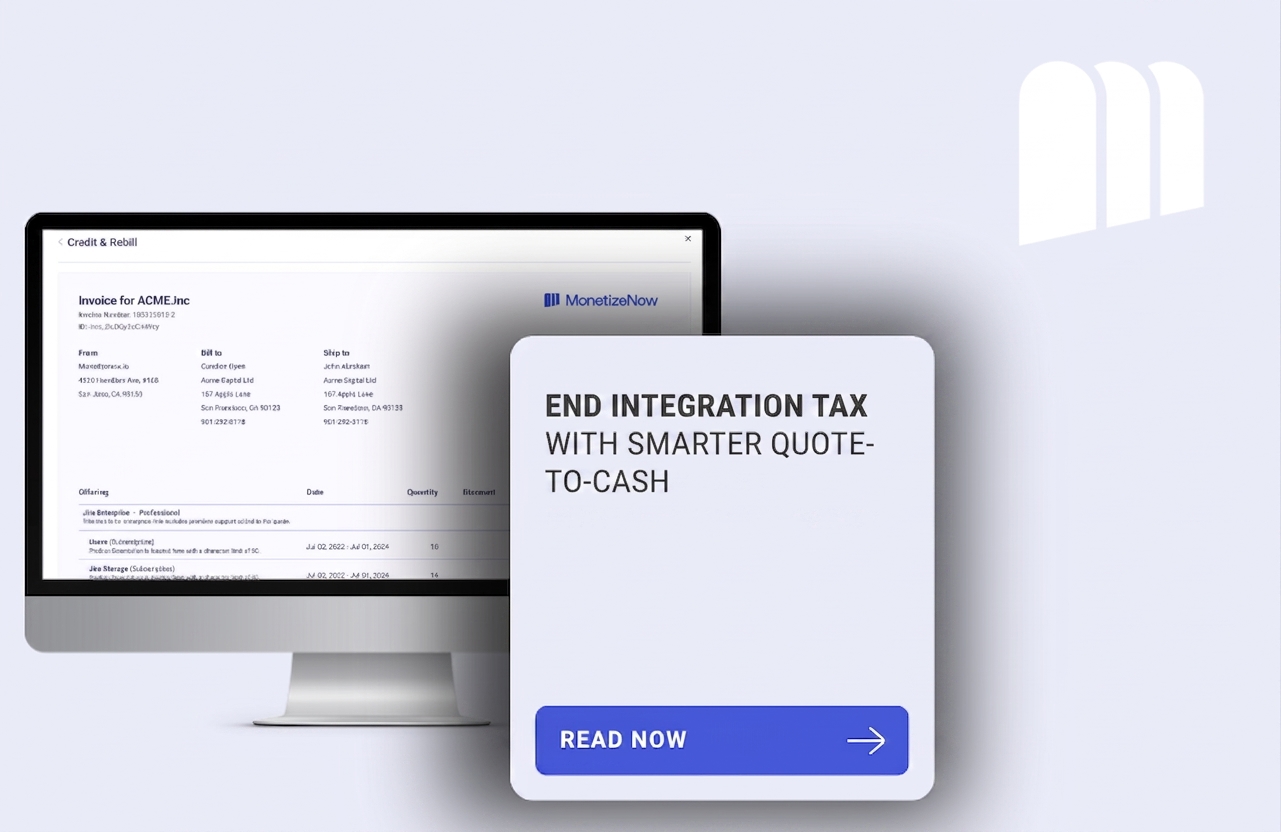
If you're a RevOps leader, you've probably spent more time this quarter troubleshooting data sync failures between your CPQ and billing system than actually improving your revenue operations. You're not alone. Most B2B SaaS companies run their quote-to-cash workflow across three or four disconnected systems - a CPQ here, a billing tool there, rev rec in spreadsheets, and a prayer that the numbers match at month-end close.
The hidden cost isn't the software licenses. It's the engineering time to build and maintain integrations, the manual reconciliation when data drifts, the fire drills every close cycle, and the brittle stack that breaks the moment your pricing model changes. That's the integration tax - and it's the single biggest drag on revenue operations in 2026.
This is a practitioner-level breakdown of the best quote-to-cash tools available right now. Not a feature-count comparison. Not a vendor press release rewrite. Each tool is evaluated on how well it covers the full quote-to-revenue lifecycle and, critically, how much integration tax it leaves on the table. The list covers everything from CPQ-focused quoting software to billing-forward platforms to unified quote-to-cash platforms - so you can find the right fit regardless of where your stack is weakest.
Whether you're building a shortlist, making a business case, or replacing a duct-taped stack that's finally breaking, this guide is built for you.
What makes a Quote-to-Cash tool worth evaluating in 2026
Every vendor article opens with "what is quote-to-cash software?" You already know what it is. You're living it. What you actually need is a framework for separating a real Q2C platform from a glorified quoting tool with a billing checkbox.
Here's what to look for when you're comparing tools:
Lifecycle coverage. Does the tool handle just quoting, or does it extend through billing, invoicing, and revenue recognition? The fewer handoffs between systems, the less integration tax you pay. A tool that covers CPQ but stops at the signed contract still leaves you stitching together billing and rev rec downstream.
Pricing model flexibility. Can it handle usage-based pricing, ramps, mid-term amendments, percentage-of-total module pricing, and multi-year off-cycle deals without custom development? Your pricing will change - probably within the next 12 months. The tool needs to handle models you haven't launched yet.
CRM integration depth. Does it work with your CRM natively, or does it require middleware that becomes another system to maintain? And if you switch CRMs (it happens), are you locked in?
Finance-grade accuracy. Does what's quoted actually match what's billed and what's recognized? Or does your finance team still spend days reconciling mismatches between the deal terms in CPQ and the invoices going out the door?
Implementation timeline. How long from contract signature to live? Some enterprise Q2C implementations stretch past six months. Others are live in weeks. The difference matters when your current stack is on fire.
Approval workflows and deal desk support. Can it handle multi-tier approval chains, discount guardrails, and audit trails? Or is your "approval process" still a Slack message to the VP of Sales?
With those criteria in mind, here are the best quote-to-cash tools in 2026 - organized by what they do best, not ranked 1 through 15.
The 15 Best CPQ / Quote-to-Cash tools in 2026
Each tool below is evaluated against the same framework: lifecycle coverage, pricing model support, CRM integration, implementation reality, and who it's best suited for.
1. MonetizeNow

Overview: MonetizeNow is a unified CPQ, billing, and revenue recognition platform purpose-built for B2B SaaS pricing complexity. One system from quote to revenue - what's quoted is what's billed is what's recognized. It eliminates the integration tax of stitching together separate CPQ, billing, and rev rec tools, unifying the work that typically takes 3–4 separate systems.
Best for: B2B SaaS companies (Series A through growth stage) whose quote-to-cash workflow is fragmented across multiple systems - especially those dealing with usage-based pricing, ramps, mid-term amendments, and percentage-of-total module pricing.
Key capabilities:
- Multi-CRM CPQ that works with Salesforce, HubSpot, and Attio
- Automated billing and invoicing
- ASC 606 revenue recognition built into the same platform
- Approval workflows and deal desk automation
- Rates and invoices usage events at billions-of-events scale
- Support for prepaid-commit + overage, headcount-tier pricing, and multi-year off-cycle deals
CRM integration: Works with Salesforce, HubSpot, and Attio - not locked to a single CRM ecosystem.
Pricing model support: Built specifically for B2B SaaS complexity. Usage-based pricing, subscription, ramps, mid-term amendments, percentage-of-total module pricing, hybrid models - all handled natively without custom development.
Implementation reality: Purpose-built SaaS architecture means faster time to value than legacy enterprise platforms. Teams typically go live in weeks rather than months.
Why it stands out: MonetizeNow eliminates the integration layer that RevOps teams spend most of their time managing. Finance-grade accuracy from deal desk to balance sheet. One source of truth across the entire quote-to-revenue lifecycle. As Eric Walmer at Gravwell put it: "If you guys could just make my quotes not suck and my data accurate, that's a huge win."
2. Salesforce Revenue Cloud

Overview: Salesforce's native revenue lifecycle management suite. Combines CPQ, billing, and revenue management within the Salesforce ecosystem. Formerly "Salesforce CPQ + Billing" - rebranded and expanded with Agentforce AI integration for guided selling.
Best for: Large enterprises already deeply invested in the Salesforce ecosystem who want to keep everything on one platform.
Key capabilities:
- Configure-price-quote with advanced product rules
- Contract lifecycle management
- Billing automation
- Revenue recognition (via Revenue Cloud Advanced)
- AI-powered guided selling through Agentforce
CRM integration: Native to Salesforce - the deepest integration of any tool on this list for Salesforce shops.
Pricing model support: Subscription, usage-based, and one-time. Handles complex deal structures, though edge cases like mid-term ramps and percentage-of-total pricing often require significant customization.
Implementation reality: Implementations commonly run three to six months or longer depending on complexity. Requires Salesforce admin expertise or a systems integration partner. Customization can create technical debt that compounds over time.
Pricing: Enterprise pricing, typically starting around $200/user/month according to third-party benchmarks. Requires Salesforce Sales Cloud as a prerequisite.
Consider this: The integration tax is low within Salesforce. But if your billing or rev rec needs extend beyond what Salesforce handles natively - or if you're not on Salesforce - the equation changes quickly.
3. DealHub

Overview: CPQ, contract management, subscription management, and billing platform with strong guided selling and proposal generation. Rated 4.7/5 on G2 with a reputation for sales-team usability.
Best for: Mid-market sales teams that need a CPQ with polished proposal generation, DealRoom (digital sales room) capabilities, and basic billing.
Key capabilities:
- CPQ with guided selling workflows
- DealRoom for interactive buyer experiences
- Contract lifecycle management
- Subscription management and billing
- Revenue intelligence tools
CRM integration: Integrates with Salesforce and HubSpot.
Pricing model support: Subscription and usage-based. Handles renewals and amendments well for standard SaaS models.
Implementation reality: Moderate - typically weeks to a few months. Less complex than enterprise Salesforce implementations.
Consider this: Strong on the quoting and proposal side of the Q2C lifecycle. Billing and rev rec capabilities are developing but may not match dedicated billing platforms for complex scenarios. If your primary pain is downstream of the quote, you may still need a separate billing or rev rec tool.
4. Conga CPQ
Overview: Enterprise CPQ and contract lifecycle management platform. Part of the broader Conga suite (CLM, document generation, e-signature). Originated as Apttus - one of the earliest Salesforce-native CPQ vendors.
Best for: Large enterprises with complex product catalogs and heavy contract management needs, particularly those on Salesforce.
Key capabilities:
- CPQ with advanced product configuration rules
- Contract lifecycle management
- Document generation and e-signature
- Revenue lifecycle management
- Integrates with the broader Conga ecosystem
CRM integration: Deep Salesforce integration. The Apttus heritage means years of Salesforce-native development.
Pricing model support: Subscription, one-time, and usage-based. Particularly strong for complex product configurations with many SKUs and bundle rules.
Implementation reality: Enterprise-grade - expect months, often with SI involvement. The full suite is broad, but deploying multiple Conga products adds complexity.
Consider this: Powerful for complex configurations, but the weight of the platform can be heavy for mid-market companies. Covering the full Q2C lifecycle may require multiple Conga products, which introduces its own integration overhead.
5. Zuora
Overview: Subscription management and billing platform. Widely considered one of the original subscription economy platforms, Zuora has been a fixture in recurring billing since 2007.
Best for: Companies with high-volume subscription billing needs, especially those with complex recurring revenue models who need mature billing and rev rec.
Key capabilities:
- Subscription billing at scale
- Revenue recognition (Zuora Revenue) with ASC 606 / IFRS 15 support
- Payment collection and dunning
- Subscription analytics
- CPQ capabilities via Zuora Quotes (Salesforce-native)
CRM integration: Zuora Quotes integrates with Salesforce CRM only. The billing platform connects via APIs.
Pricing model support: Subscription, usage-based, and hybrid. One of the more mature billing engines for recurring revenue scenarios.
Implementation reality: Moderate to long. The billing platform is powerful but complex to configure. Zuora Quotes and Zuora Billing are separate products that need their own integration - which means you may still face integration overhead between quoting and billing within the Zuora ecosystem itself.
Consider this: Strong on billing and rev rec. But the CPQ layer is a separate product, so the "unified Q2C" promise requires connecting multiple Zuora modules.
6. Oracle CPQ
Overview: Enterprise CPQ solution within the Oracle Cloud suite. Part of Oracle's broader CX (Customer Experience) platform, designed for complex product configuration and pricing at scale.
Best for: Large enterprises already in the Oracle ecosystem (Oracle ERP, Oracle CX) that need advanced product configuration for manufacturing, telecom, or enterprise tech.
Key capabilities:
- Advanced product configuration engine
- Pricing rules and approval workflows
- Proposal generation
- Integration with Oracle ERP and Oracle CX
- Support for complex bundle and volume-tier pricing
CRM integration: Native to Oracle CX. Salesforce integrations are available but typically require middleware.
Pricing model support: Handles complex enterprise pricing - volume tiers, bundles, custom configurations. Less focused on SaaS-specific models like usage-based ramps or mid-term amendments.
Implementation reality: Long - enterprise implementation with significant customization. Requires Oracle expertise and often SI partners.
Consider this: Extremely powerful for complex product configurations in manufacturing and enterprise tech. For most B2B SaaS companies, it's more platform than you need.
7. HubSpot Commerce Hub

Overview: HubSpot's native commerce and quoting tools - includes quotes, payment links, invoices, and subscription management embedded directly within the HubSpot CRM. Rated 4.4/5 on G2.
Best for: SMBs and early-stage SaaS companies already on HubSpot who need basic quoting and invoicing without adding another tool to the stack.
Key capabilities:
- Quote generation tied to HubSpot deals
- Payment links and checkout
- Invoicing and basic subscription billing
- Tight integration with HubSpot CRM contacts, deals, and workflows
CRM integration: Native to HubSpot. Zero integration needed - it lives inside the CRM you're already using.
Pricing model support: Basic subscription and one-time pricing. Limited support for complex B2B SaaS models like usage-based pricing, ramps, or mid-term amendments.
Implementation reality: Fast - built into HubSpot with minimal setup. Days, not weeks.
Pricing: Starts from around $85/user/month for paid commerce features, though basic quoting is available on lower HubSpot tiers.
Consider this: A great starting point. But most B2B SaaS companies outgrow it as pricing complexity increases. No native rev rec. Limited approval workflows. As one RevOps leader described the experience: "Your tool is rolling in all three years as one year's ARR. So it's purpling my ARR. My reporting is garbage."
8. Maxio

Overview: Financial operations platform for B2B SaaS. Formed from the merger of Chargify and SaaSOptics, Maxio combines billing, revenue recognition, and SaaS metrics in one platform. Acquired a CPQ vendor Revops.io.Rated 4.5/5 on G2.
Best for: B2B SaaS companies (Series A–C) focused on billing automation and SaaS financial metrics, particularly those preparing for audit readiness or fundraise.
Key capabilities:
- Subscription billing automation
- Revenue recognition with ASC 606 compliance
- SaaS metrics dashboards (ARR, churn, LTV)
- Accounts receivable automation
- Financial reporting
CRM integration: Integrates with Salesforce and HubSpot via connectors.
Pricing model support: Subscription, usage-based, and hybrid. Solid for standard SaaS billing models.
Implementation reality: Moderate - typically weeks to a couple of months depending on data migration complexity.
Pricing: Starts from $599/month.
Consider this: Strong on billing and rev rec - one of the more mature finance-ops platforms for mid-market SaaS. Key challenges - SaaSOptics and Chargify disparity is evident in the Billing. Also, since CPQ was also acquired, the data model is different across CPQ and Billing which makes unified Quote-to-cash workflows challenging.
9. Chargebee

Overview: Subscription billing and revenue management platform popular with SaaS and subscription businesses for automated billing, dunning, and revenue recognition.
Best for: SaaS companies with straightforward subscription models that need reliable billing automation and dunning management without heavy enterprise overhead.
Key capabilities:
- Subscription billing and invoicing
- Dunning management and payment recovery
- Revenue recognition
- Checkout pages and payment processing integrations
- Plan changes and proration handling
CRM integration: Integrates with Salesforce, HubSpot, and others via native connectors and APIs.
Pricing model support: Subscription, usage-based (metered billing), and freemium-to-paid. Handles plan changes and prorations well for standard models.
Implementation reality: Relatively fast for simpler models - self-serve setup gets you running quickly. More involved for complex configurations.
Consider this: Billing-focused. No native CPQ. Enterprise-grade quoting, deal desk workflows, and multi-tier approvals require a separate tool. If your pain is quoting speed or deal desk friction, Chargebee won't address it.
10. PandaDoc

Overview: Document automation and e-signature platform with quoting and proposal capabilities. Not a traditional CPQ, but widely used as sales quoting software for fast, visually polished proposals. Rated 4.7/5 on G2.
Best for: Sales teams that need fast, professional proposals and quotes with e-signature - particularly SMBs and mid-market companies where the quoting process is document-centric.
Key capabilities:
- Quote and proposal generation with templates
- E-signature
- Content library and document analytics
- Payment collection within proposals
- CPQ-lite functionality for pricing tables
CRM integration: Integrates with Salesforce, HubSpot, Pipedrive, Zoho, and others.
Pricing model support: Basic pricing tables within proposals. Not built for complex B2B SaaS pricing like usage-based, ramps, or mid-term amendments.
Implementation reality: Fast - days to weeks. Minimal configuration needed.
Pricing: Starts from $19/user/month.
Consider this: Excellent for document-centric quoting and minor B2B SaaS quoting use cases. Since it is not a full fledged CPQ, cracks start appearing as complexity grows - ramps, approval rules, AI quoting, AI credits quoting (no proration), co-term, contract expansions etc.. Also, PandaDoc does not extend into billing or revenue recognition. If your quote-to-cash pain is downstream of the quote - billing accuracy, revenue leakage, ASC 606 compliance - PandaDoc won't solve it.
11. Stripe Billing

Overview: Stripe's billing product for recurring and usage-based billing. Part of the broader Stripe payments infrastructure. Revenue recognition is available as a separate product (Stripe Revenue Recognition).
Best for: Developer-first SaaS companies with engineering resources to build custom billing workflows on top of Stripe's APIs. Particularly strong for PLG (product-led growth) billing.
Key capabilities:
- Subscription and usage-based billing
- Invoicing and payment processing
- Dunning and payment recovery
- Tax automation (Stripe Tax)
- Revenue recognition (separate product)
CRM integration: API-first - no native CRM integration. Requires custom development or middleware to sync with Salesforce or HubSpot.
Pricing model support: Subscription, usage-based, and one-time. Flexible via API, but complex models require engineering work to implement and maintain.
Implementation reality: Fast for simple billing. Weeks to months for complex configurations. Engineering-dependent.
Consider this: Powerful billing infrastructure, but no CPQ layer. Quoting, deal desk, and approvals must be handled separately. Mid-term amendments and co-terming often require manual workarounds. As one founder described: "Manually doing things in Stripe just like does not work, especially as you're adding more sales folks."
12. Nue
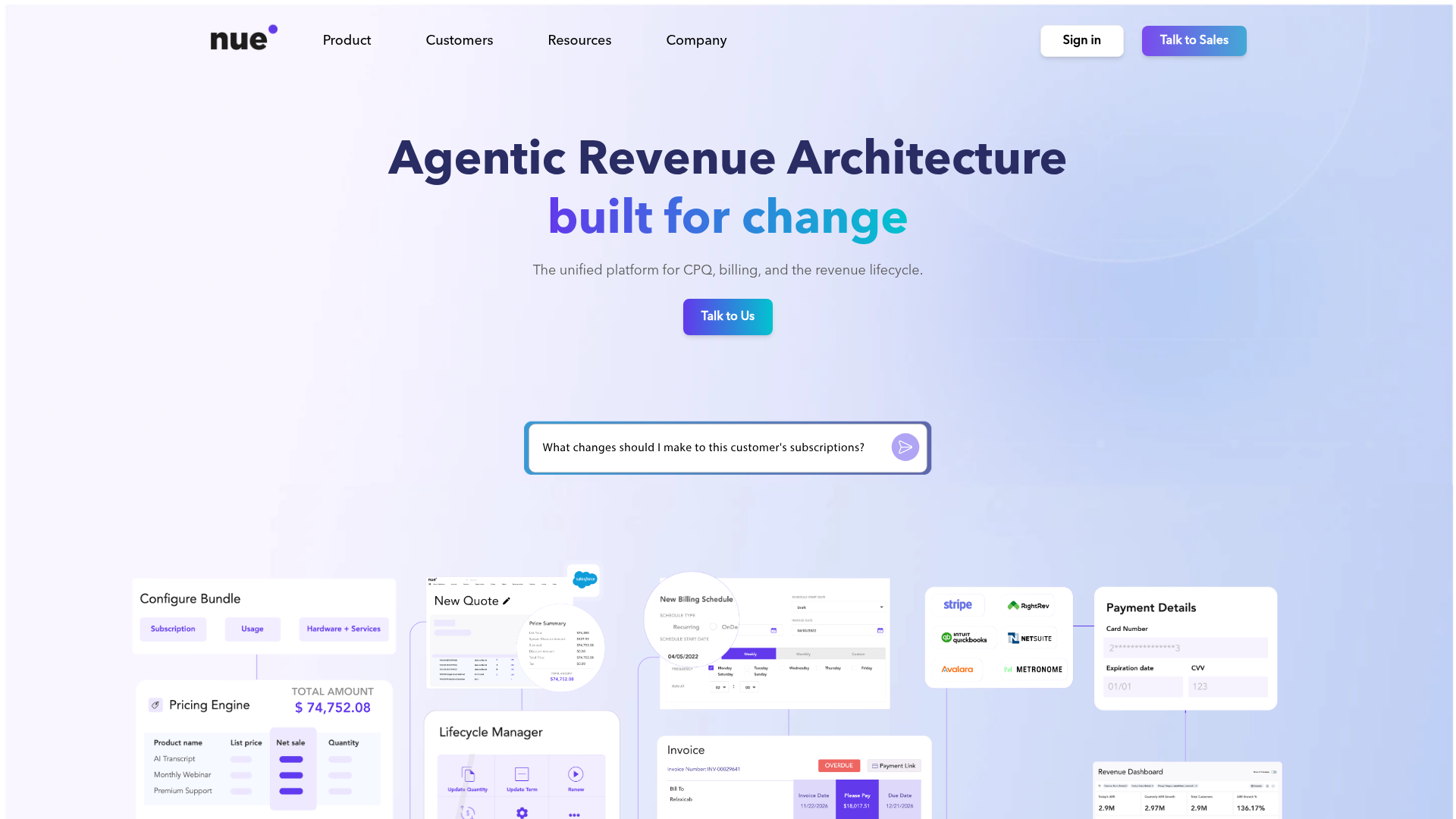
Overview: Revenue lifecycle platform built natively on Salesforce. Combines CPQ, billing, and revenue management in a modern Salesforce-native architecture designed as an alternative to legacy Salesforce CPQ.
Best for: Salesforce-centric companies looking for a modern alternative to Salesforce CPQ with integrated billing and subscription management.
Key capabilities:
- CPQ with modern UX
- Subscription management
- Billing and invoicing
- Usage-based pricing support
- Revenue management
CRM integration: Salesforce-native - lives entirely inside Salesforce.
Pricing model support: Subscription, usage-based, and hybrid models.
Implementation reality: Faster than legacy Salesforce CPQ implementations due to modern architecture. Still tied to Salesforce ecosystem complexity.
Consider this: Salesforce-only. If you're on HubSpot, Attio, or another CRM, Nue isn't an option. For Salesforce shops, it offers a more modern Q2C experience than the legacy Salesforce CPQ, but evaluate whether the Salesforce-only dependency fits your long-term CRM strategy.
13. SAP CPQ
Overview: Enterprise CPQ solution within the SAP ecosystem. Designed for complex product configurations in manufacturing, telecom, and enterprise tech.
Best for: Large enterprises already on SAP S/4HANA or SAP CX that need CPQ tightly integrated with ERP.
Key capabilities:
- Advanced product configuration engine
- Pricing rules and proposal generation
- Deep integration with SAP ERP and SAP Commerce
- Support for complex bundle and volume-tier pricing
CRM integration: Native to SAP CX. Salesforce integration available.
Pricing model support: Complex enterprise pricing, volume tiers, and bundles. Less focused on SaaS-specific models.
Pricing: Starts from around $96/user/month according to third-party benchmarks.
Implementation reality: Long - enterprise implementation requiring SAP expertise and often SI partners.
Consider this: Purpose-built for manufacturing and enterprise complexity. Not designed for B2B SaaS quote-to-cash workflows.
14. Salesbricks

Overview: Modern CPQ and billing platform designed for B2B SaaS. Focuses on simplifying the quoting-to-billing workflow with interactive order forms and a self-serve buyer experience. Ranked by G2 as one of the easiest-to-use quote-to-cash tools.
Best for: Early-to-mid-stage B2B SaaS companies that want a simpler, faster alternative to enterprise CPQ with integrated billing and payment collection.
Key capabilities:
- CPQ with interactive order forms
- Dynamic checkout URLs for buyer self-service
- Subscription billing
- E-signature and payment collection
- Quote-to-billing in one workflow
CRM integration: Salesforce and HubSpot integrations.
Pricing model support: Subscription, usage-based, and one-time. Designed for SaaS pricing models.
Implementation reality: Fast - designed for quick setup with minimal configuration.
Consider this: A newer entrant focused on simplicity and speed. Evaluate the maturity of billing and rev rec capabilities against more established platforms if your pricing complexity is high or you need ASC 606 automation.
15. Ordway

Overview: Billing and revenue automation platform for B2B SaaS. Focuses on automating billing, accounts receivable, and revenue recognition without the complexity of enterprise platforms.
Best for: B2B SaaS finance teams that need billing and rev rec automation with a focus on financial accuracy and compliance.
Key capabilities:
- Subscription and usage-based billing
- Revenue recognition with ASC 606 compliance
- Accounts receivable automation
- Financial reporting and analytics
CRM integration: Integrates with Salesforce via connector. API available for other systems.
Pricing model support: Subscription, usage-based, and hybrid models.
Implementation reality: Moderate - typically weeks.
Consider this: Billing and rev rec focused - no native CPQ. You'll need a separate quoting solution, which means maintaining an integration between your quoting and billing systems.
How to choose the right quote-to-cash tool for your stack
The "best" Q2C tool depends entirely on where your stack is weakest and what's causing the most pain right now. Here's a practical decision framework:
If you're on Salesforce and want to stay native, evaluate Salesforce Revenue Cloud or Nue. Both live inside Salesforce, which minimizes CRM integration overhead. Revenue Cloud is the incumbent with the broadest feature set; Nue offers a more modern architecture. The trade-off is ecosystem lock-in.
If you need CPQ, billing, and rev rec in one platform without the integration tax, evaluate MonetizeNow. It's purpose-built for B2B SaaS pricing complexity and covers the full quote-to-revenue lifecycle - what's quoted is what's billed is what's recognized. Works with Salesforce, HubSpot, and Attio, so you're not locked into a single CRM.
If your primary pain is billing, not quoting, evaluate Zuora, Chargebee, Maxio, or Ordway. These platforms are mature on the billing and rev rec side. Just know that you'll still need a separate quoting tool, which means maintaining an integration between quoting and billing - the exact handoff point where data tends to drift.
If you need fast, polished proposals and aren't ready for full Q2C, evaluate PandaDoc, DealHub, or Salesbricks. These tools get sales teams quoting quickly. They're strong on the front end of the lifecycle but lighter on billing and rev rec.
If you're an enterprise with complex product configurations, evaluate Oracle CPQ, SAP CPQ, or Conga. These platforms handle deep product rules, volume-tier pricing, and bundle configurations at scale. They're built for manufacturing and enterprise tech complexity, not SaaS-specific workflows.
A practical tip: Map your current stack's failure points first. If your biggest pain is between quoting and billing - where data gets lost in the handoff - prioritize tools that unify those steps. If your pain is billing accuracy or ASC 606 compliance, start there. The goal isn't to buy the "best" tool in the abstract. It's to eliminate the specific integration tax your team is paying today.
Common mistakes when evaluating quote-to-cash tools
After watching dozens of Q2C evaluations play out, the same mistakes keep showing up. Here's what to avoid:
1. Evaluating CPQ and billing separately. This is the most common mistake - and the most expensive. You run one RFP for CPQ and another for billing, pick the "best" in each category, and then spend six months building the integration between them. You've just recreated the integration tax with new vendors.
2. Ignoring mid-term amendment handling. Every tool demos well on a simple new deal. Ask what happens when a customer adds 50 seats mid-contract with a prorated ramp that co-terms with their renewal date. That's where most Q2C tools break down - and it's the scenario your sales team encounters every week.
3. Underestimating implementation timeline. The vendor says six weeks. Your team is also running month-end close, onboarding new reps, migrating historical data, and configuring 30 pricing models. Build in at least 2x the quoted timeline, especially for enterprise platforms.
4. Choosing based on current pricing models only. Your pricing will change. Maybe you'll add a usage-based component next quarter. Maybe you'll introduce a PLG tier. Evaluate whether the tool can handle models you haven't launched yet - not just the ones you're running today.
5. Not involving Finance in the evaluation. RevOps buys the tool. Finance lives with the billing and rev rec output. If Finance isn't in the room during evaluation, you'll buy a tool that makes quoting faster but doesn't solve the month-end close fire drill. Get your Controller or VP Finance involved early - they'll ask the questions that matter most for long-term success.
Conclusion - end the integration tax
The Q2C landscape in 2026 has more options than ever. But the core problem hasn't changed: most B2B SaaS companies are still stitching together three or four systems and paying the integration tax in engineering hours, manual reconciliation, and month-end fire drills.
The right tool depends on where your stack is weakest and how much of the lifecycle you want to unify. For companies dealing with B2B SaaS pricing complexity and fragmented stacks, a unified platform that covers CPQ, billing, and revenue recognition in one system eliminates the integration tax entirely - what's quoted is what's billed is what's recognized.
See how MonetizeNow unifies quote-to-revenue for B2B SaaS →
FAQ
How much does quote-to-cash software cost?
Quote-to-cash software pricing ranges widely. Entry-level tools like PandaDoc start around $19/user/month. Mid-market platforms like Maxio start at $599/month. Enterprise platforms like Salesforce Revenue Cloud often start around $200/user/month. But licensing cost is only part of total cost of ownership - factor in implementation, integration maintenance, and the ongoing cost of manual reconciliation between disconnected systems. A unified quote-to-cash platform may have a higher per-seat cost but a lower total cost when you eliminate integration overhead and the headcount spent managing data flow between systems.
Do I need quote-to-cash software if I already have CPQ?
CPQ handles the "quote" part of the lifecycle. Quote-to-cash extends through billing, invoicing, and revenue recognition. If your CPQ doesn't connect to billing - or if your billing system doesn't match what was quoted - you have a gap that creates manual work, data mismatches, and revenue leakage. Q2C software closes that gap, either by extending your CPQ with billing and rev rec or by replacing the fragmented stack with a unified platform that covers the full lifecycle.
How long does it take to implement quote-to-cash software?
Implementation timelines depend on the tool and your complexity. Document-focused tools like PandaDoc or HubSpot Commerce Hub can be live in days to weeks. Mid-market platforms like Chargebee, Maxio, Salesbricks, or MonetizeNow typically take weeks to a couple of months. Enterprise platforms like Salesforce Revenue Cloud, Oracle CPQ, or SAP CPQ commonly require three to six months or longer, often with systems integration partners. The biggest variable isn't the tool itself - it's your data migration complexity and how many pricing models you need to configure from day one.
Can quote-to-cash software integrate with my existing CRM or ERP?
Most Q2C tools integrate with major CRMs like Salesforce and HubSpot. ERP integration varies - Salesforce Revenue Cloud and Oracle CPQ have native ERP connections within their ecosystems, while others rely on APIs or middleware. The key question to ask vendors: "Is this a native integration or a connector that requires ongoing maintenance?" Native integrations are more reliable and lower-maintenance. Connectors can become another source of integration tax - one more system to monitor, troubleshoot, and maintain.
What's the difference between CPQ and quote-to-cash software?
CPQ (Configure, Price, Quote) handles product configuration, pricing rules, and quote generation. Quote-to-cash is the broader lifecycle - from quoting through contract execution, billing, payment collection, and revenue recognition. CPQ is a subset of Q2C. Some vendors use the terms interchangeably, but a true Q2C platform extends well beyond quoting into billing, invoicing, and rev rec. If a vendor calls their tool "quote-to-cash" but only covers quoting and proposals, you're still going to need separate billing and rev rec systems.
What is the integration tax in quote-to-cash?
The integration tax is the hidden cost of running quote-to-cash across multiple disconnected systems. It includes the engineering time to build and maintain integrations between CPQ, billing, and rev rec tools. It includes the manual reconciliation when data doesn't sync between systems. It includes the troubleshooting when integrations break at the worst possible time (usually during month-end close). And it includes the inability to change pricing models without re-architecting the connections between systems. The integration tax isn't paid in software licenses - it's paid in headcount, time, errors, and delayed revenue.
Can quote-to-cash tools handle usage-based pricing?
Some can, many can't - at least not natively. Tools like Stripe Billing, Zuora, Chargebee, and MonetizeNow handle usage-based billing. But the real question is whether usage-based pricing is supported across the entire lifecycle - from the quote (where usage commitments and overages are defined) through billing (where usage events are rated and invoiced) to rev rec (where usage revenue is recognized correctly under ASC 606). Most tools handle one piece of that chain but not all three. If you're running usage-based or hybrid pricing, evaluate whether the tool covers the full lifecycle or just one segment.
What signals indicate I've outgrown my current quote-to-cash stack?
Five signals to watch for: (1) Month-end close consistently takes more than five business days because of manual reconciliation between systems. (2) Sales complains that quoting is slow or requires deal desk involvement for every non-standard deal. (3) Finance finds mismatches between what was quoted and what was billed - discounts not applied, dates wrong, line items missing. (4) Pricing model changes require engineering work to implement across your CPQ, billing, and rev rec tools. (5) You're spending 10+ hours per week on manual invoicing, data sync troubleshooting, or report building across disconnected systems. If two or more of these describe your current reality, your stack has outgrown its architecture.


.png)

.png)


